The Real Cost of Land Near Jamestown Isn't the Acre Price. It's What's Already in the Ground.
August 13, 2026
August 13, 2026
Two land listings near Jamestown, current as of early August 2026, quote almost the same price per acre. One is 920 acres of grazing ground near Historic Chinese Camp. The other is just over 10 acres on La Grange Road. A buyer scanning both numbers side by side would assume they're looking at two versions of the same deal, just at different scales.
They aren't. And the reason has almost nothing to do with the acreage.
"Land in Jamestown" isn't one market. It's at least three, and each one prices completely differently depending on what's already been done to the dirt.
| Land type | Listings tracked | Average price | Average price per acre |
|---|---|---|---|
| Agricultural-classified land | 7 | $1,199,500 | $10,163 |
| Undeveloped/vacant land | 17 | $703,000 | $21,558 |
| All land listings combined | 39 | $935,211 | $32,453 |
| Land with a house already on it | 8 | $1,025,000 | $44,517 |
Raw grazing land runs around $10,000 an acre. Vacant land with no ag designation runs closer to $21,000. Once a house sits on the parcel, the per-acre number more than doubles again to roughly $44,500. A single blended average across all Jamestown land listings sits at about $32,453 per acre, which is a real number and also a useless one for comparing any two specific parcels, because it's mixing categories that don't behave the same way.
This is the trap. A buyer who sees "$32,000 an acre" as the market rate and then finds a 10-acre parcel listed near that number has no way of knowing, from the price alone, whether they're buying raw ground or something a previous owner already spent tens of thousands of dollars developing.
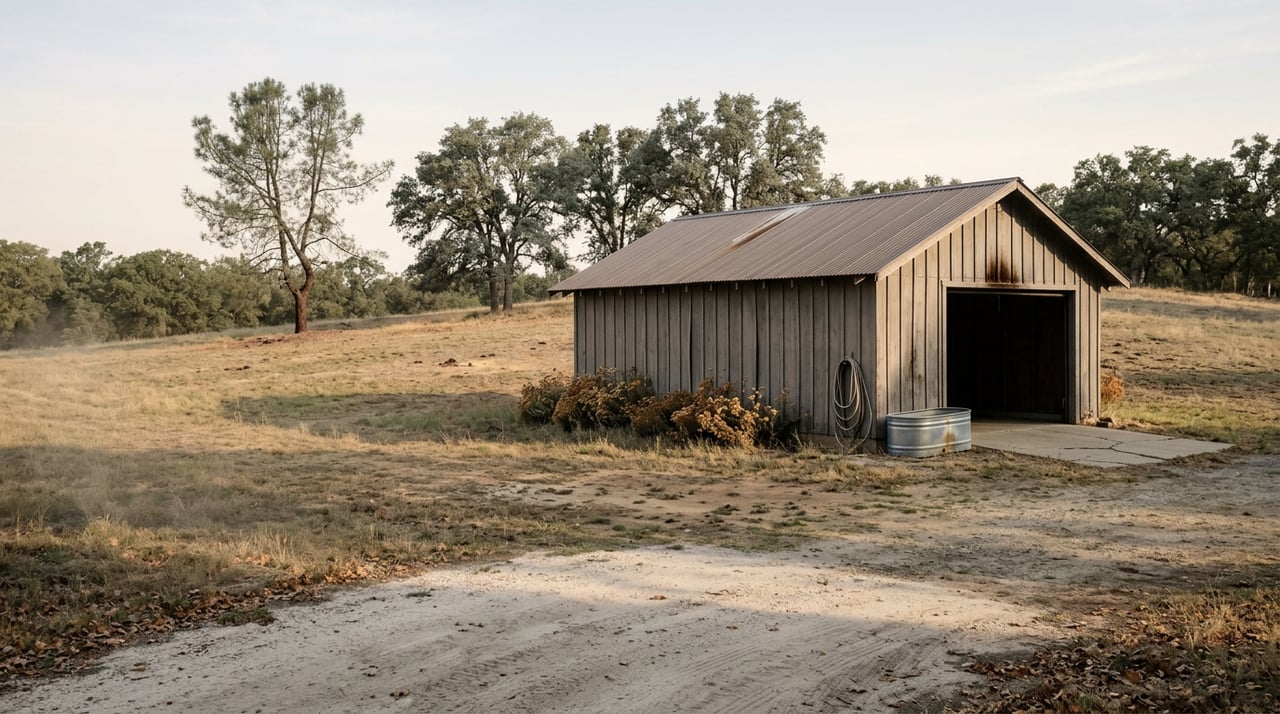
Take the 10.09-acre parcel at 11560 La Grange Rd. It's listed as vacant, no structure standing, suited for a custom home or a manufactured home. On paper it should price like undeveloped land, somewhere in the $20,000-per-acre range.
It doesn't, because the listing includes three water wells and two septic systems already in place. The land itself is vacant. The infrastructure underneath it is not. That's the part a per-acre average can't see, and it's the part that actually determines what a buyer is paying for.
This is the pattern worth internalizing before you fall in love with a number: two parcels can look identical on a map and price a mile apart because one of them already solved the water and wastewater problem and the other hasn't started.
Here's where the math turns into a closing-week problem if nobody flags it early.
Tuolumne County lets homeowners self-certify a straightforward gravity septic system using the county's own ROSS evaluation checklist, and that self-check is genuinely useful for routine maintenance. But the county's own guidance is direct about what happens at a sale: at the time of a property transfer, a licensed Operation, Maintenance & Monitoring Specialist should conduct the inspection, not the homeowner.
That distinction matters for anyone buying acreage with an existing system rather than raw land where you'll design one from scratch. In practice, a purchase involving an existing well and septic setup near Jamestown usually moves through something like this:
None of this is unusual for rural property. It's just easy to miss if you're used to city transactions where a functioning tap and a working toilet are the only questions anyone asks.
The flip side of the La Grange Road example is the parcel where nothing has been drilled yet. That's most of the raw acreage priced at $10,000 to $21,000 an acre, and the missing well is a large part of why it's cheaper.
Sierra Foothills geology is part of the reason those numbers matter more here than in flatter parts of the state. Granite and greenstone are harder to drill through than the sedimentary ground in the Central Valley, which means slower progress, specialized bits, and a wider range of possible outcomes once the drill starts turning. A complete well system in foothill terrain like Jamestown's realistically runs from roughly $18,000 to $40,000 or more, once you account for casing, pump, pressure tank, and permitting, not just the per-foot drilling rate.
That range is the honest answer to "how much cheaper is raw land, really." A 10-acre raw parcel at $21,000 an acre costs $210,000 before you've solved water. The same acreage with an existing well and septic, priced at closer to $32,000 to $44,000 an acre, may cost more up front but skips a five-figure project with an uncertain outcome. Neither choice is automatically the better deal. It depends on whether you'd rather control the design of your own system or pay a premium for one that's already proven to work.
A few currently listed Jamestown-area parcels show how differently this plays out depending on what's already there.
The 920-acre offering across five legal parcels on Six Bit Gulch Road near Historic Chinese Camp, adjacent to the Red Hills Recreational Management Area, prices at just over $1,030 an acre. That's grazing and recreational land with no wells or septic mentioned, and the price reflects it.
An 11.11-acre lot off Jacksonville Road near Moccasin Point Marina is sold as a build-ready site with a partial lake view, meaning the buyer is paying for the setting and the access, not for finished infrastructure.
A 2.35-acre parcel bordered by Woods Creek and seasonal Peppermint Creek, part of the original Pulpit Rock Farm dating to the 1800s, blends history with the same underlying question every buyer needs answered: what's already permitted, drilled, and inspected, and what still needs to happen before you can move in.
And Mill Villa Manor, an all-age manufactured home community in Jamestown, represents the other end of the spectrum entirely: shared infrastructure, low HOA fees, and none of the well-and-septic due diligence that comes with standalone acreage.
Four listings, four completely different cost structures, all under the same "Jamestown land" search.
Does every well and septic transfer in Tuolumne County require a licensed inspector? For the point-of-sale inspection specifically, yes. The county's own guidance states that a licensed OM&M Specialist should handle the transfer inspection, separate from the homeowner self-certification option available for routine, non-sale maintenance checks.
If a parcel has no well yet, should I assume the worst-case drilling cost? Budget toward the higher end of the $18,000 to $40,000 foothill range rather than the national average, since granite and greenstone drilling in this part of the Sierra foothills tends to take longer and require more specialized equipment than softer ground elsewhere in the state.
Is a higher price-per-acre parcel automatically a worse deal than a cheaper one nearby? Not necessarily. A parcel priced higher because it already has a working well and a septic system that passed its transfer inspection may cost less over the first two years than a cheaper raw parcel where you're still permitting, drilling, and waiting on results.
Land math in the foothills rewards patience more than speed. The number on the listing is a starting point, not the whole story, and figuring out what's already in the ground is usually the difference between a smooth closing and a six-month delay.
If you're looking at acreage near Jamestown, La Grange, or anywhere else in the Don Pedro corridor and want a second set of eyes on what a listing's price per acre is really telling you, Elaine Hogan has spent more than four decades around these hills and knows which questions to ask before you write an offer. Let's Connect.
Stay up to date on the latest real estate trends.
Buying or selling in La Grange deserves an agent who understands the area beyond the listing sheet. Elaine Hogan brings local insight, PMZ Real Estate support, and years of experience helping clients move with confidence in a market shaped by seasonality, rural properties, and changing buyer demand. If you’re looking for a home, land, or a future retreat in the foothills, Elaine offers a practical and personal approach from first conversation to closing.
(209) 770-6769
[email protected]
14375 LAS MORAS ST
LA GRANGE, CA 95329